
Articles
How to Plan a Budget Trip: 5 Steps, Formula & Example
A useful trip budget answers two different questions: What will the whole trip cost? And: How much will still be available to spend once you are there? Combining both into one...
A useful trip budget answers two different questions: What will the whole trip cost? And: How much will still be available to spend once you are there? Combining both into one daily figure makes it easy to overlook flights, baggage, hotel taxes and tickets that have already been paid for.
The arithmetic is straightforward. The harder part is using complete prices and deciding early which parts of the trip should not be sacrificed just to make the total look smaller.
How to plan a budget trip in 5 steps
- Set a total ceiling that is genuinely available.
- Price transport, accommodation and essential bookings using current final prices.
- Estimate food, local transport and activities with different day types rather than an arbitrary daily allowance.
- Keep a reserve for plausible changes.
- If the total is too high, change the dates, duration or route before squeezing every small pleasure out of the trip.
A trip budget formula that stays useful
Separate the calculation into four blocks:
Trip budget = long-distance transport + accommodation + other fixed costs + on-trip spending + reserve
On-trip spending covers only the costs that remain variable while you travel:
On-trip spending = food + local transport + activities + small incidental costs
This separation prevents two common errors: counting a prepaid expense twice or quoting a low daily rate that excludes flights and hotels entirely.
| Cost block | Typical items | Best basis for the estimate | | --- | --- | --- | | Long-distance transport | Flights, rail, coach, baggage, necessary seat reservations | Final price for a journey you would genuinely book | | Accommodation | Nights, taxes, cleaning, resort fees, parking | Complete price for the full stay | | Other fixed costs | Insurance, visas, transfers, rental car, pre-booked tickets | A specific quote instead of a rough guess | | On-trip spending | Food, public transport, fuel, flexible admissions, small purchases | Realistic day types | | Reserve | Price differences, plan changes, a necessary taxi, replacement booking | The actual uncertainties in the trip |
Your general emergency savings do not belong in this calculation. The trip should fit without relying on money set aside for regular expenses or unrelated emergencies.
Step 1: set your ceiling and priorities together
Start with the maximum available for the entire trip. Then identify two or three things that will carry the experience for you. That might be a well-connected place to stay, a particular hike, one special dinner or a scenic train journey.
Set a minimum standard as well. For example:
- Accommodation must be clean, safe and reasonably accessible.
- A journey should not be so punishing that the arrival and departure days are effectively lost.
- The budget must allow ordinary meals without turning every decision into a calculation.
- There must still be money for the reason you chose the destination.
Now place potential expenses into three groups:
| Protect | Keep flexible | Cut first | | --- | --- | --- | | core experiences, safe accommodation, important connection | room size, breakfast, one additional excursion | duplicate attractions, weak upgrades, impulse purchases with little value |
The contents of each column are personal. The order is what matters. Without it, travelers often cut sleep, location or their main experience while dozens of minor expenses remain untouched.
Step 2: use final prices, not headline prices
Average prices are fine for early orientation. Before booking, replace the largest estimates with quotes for your actual dates.
Look beyond the number in the search result:
- Flight or rail: baggage, reservations, travel to the departure point and the transfer on arrival
- Accommodation: number of nights, taxes, cleaning, parking and mandatory fees
- Rental car: insurance, additional drivers, one-way fees, child seats, parking, tolls and expected fuel
- Activities: booking fees, transport to the meeting point and necessary equipment
- Travel days: food in transit, luggage storage and the gap between checkout and departure
When another currency is involved, note the exchange rate used for the estimate. The aim is not to predict currencies. It is simply to notice when the basis of your calculation has changed.
Couples and groups also need to separate two kinds of cost:
- Flights, insurance and admission tickets are usually per-person costs.
- Hotel rooms, rental cars, fuel and parking are often shared costs.
Do not divide the grand total by the number of travelers. Calculate each item in the unit in which it is actually charged.
Step 3: plan day types instead of one rigid daily budget
An arrival day, a museum day and a quiet beach day rarely cost the same. A daily allowance is therefore an average, not a rule for every date.
Start by marking the days that are likely to be expensive:
- arrival with an airport transfer
- a reserved activity or theme park
- a long drive with fuel, tolls or a ferry
- a guided day trip
- a change of base involving luggage storage or waiting time
Then add lighter days built around walks, markets, beaches, parks or activities that are already paid for. This produces a realistic spending pattern instead of ten identical low-cost days.
A worked ten-day example
The figures below illustrate the method only. They are not a price guide for any particular destination.
| Item | Calculation | Amount | | --- | ---: | ---: | | Return transport | current quote | EUR 450 | | Accommodation | 9 nights × EUR 90 | EUR 810 | | Other fixed costs | insurance, baggage, transfers | EUR 120 | | 2 travel days | 2 × EUR 55 | EUR 110 | | 5 more active days | 5 × EUR 85 | EUR 425 | | 3 lighter days | 3 × EUR 45 | EUR 135 | | Planned total | before reserve | EUR 2,050 | | Reserve | for specific uncertainties | EUR 200 | | Required ceiling | | EUR 2,250 |
The EUR 670 of on-trip spending averages EUR 67 a day. It does not mean that each day must cost exactly EUR 67. What matters is whether the mix of day types fits the allocated amount.
For a destination-specific application, our Thailand budget for two or four weeks compares dorm beds, shared private rooms and more flexible travel, with accommodation nights and domestic transfers calculated separately.
Step 4: size the reserve according to risk
A blanket percentage is convenient, but it does not fit every trip. A mostly prepaid city break with a direct connection needs a different reserve from a road trip involving changing hotels, weather-dependent ferries and several currencies.
Ask a more useful question: What could reasonably change, and what would a sensible alternative cost?
- a taxi after a very late arrival
- an extra night after a missed connection
- an indoor alternative in bad weather
- higher fuel, toll or parking costs
- a meal or transfer that was estimated too optimistically
Keep that money unallocated at first. If it has already been assigned to planned restaurants or tickets, it is not a reserve.
A simple reality check is this: if the trip only fits when every price is at its lowest and nothing changes, the budget is not realistic yet.
Step 5: cut costs in the right order
If the estimate is too high, a structural change will do more than ten small restrictions.
| If this block is too expensive | A sensible adjustment | A common false economy | | --- | --- | --- | | Long-distance transport | shift dates, compare a nearby airport including transfers, choose one connection fewer | accept an exhausting itinerary and lose the first day | | Accommodation | choose a connected neighboring district, shorten the stay, check weekday patterns | stay far out and pay daily in time and transport | | Route | make fewer base changes, shorten the distance, use one base | keep every stop but have too little time everywhere | | Activities | protect one or two priorities, remove similar options | cut the experience that motivated the trip | | Food | keep breakfast or lunch simple, choose a few intentional dinners | set a daily food limit that makes every meal stressful |
The strongest levers are usually dates, duration, route, transport and accommodation. A water bottle, snack or souvenir is rarely the reason a trip is several hundred euros over budget.
Where savings hurt least — and where they often hurt quickly
The easiest savings usually come from expenses that repeat without adding much to the experience:
- several similar paid viewpoints or museums
- hotel upgrades you will barely use
- daily taxis where a reliable connection exists
- extra baggage for things that never leave the suitcase
- choosing a restaurant from exhaustion beside the busiest attraction
- frequent hotel changes that create extra transfers
Be more careful with choices that affect every day or solve a genuine constraint:
- sleep and a workable accommodation location
- safe transfers at difficult arrival times
- enough time for important connections
- necessary insurance and health requirements
- the one experience that made you choose the trip
Spending more is not automatically better in these areas. The aim is a sensible minimum standard. A simple room in a connected neighborhood may be exactly right; a cheaper room that adds two hours of commuting every day often is not.
How to manage the budget while traveling
There is no need to keep monitoring a flight that has already been paid for. The useful number on the road is the on-trip spending that remains.
After a large expense, use this calculation:
Remaining daily average = remaining on-trip budget ÷ remaining travel days
Treat the result as a warning signal, not a rigid daily cap. An expensive day can be balanced by a lighter day that was already planned. If the average falls after every stage, however, one category was probably underestimated.
Three short check-ins are practical for many trips:
- After arrival: Were the transfer, first meals and small essentials estimated accurately?
- At the midpoint: Which category is visibly off plan?
- Before the final two days: What is still booked, and how much is genuinely free?
How a free budget app helps you track travel costs
A free budget app can keep your planned budget and actual travel costs in the same view. That is more useful on the road than a rigid daily cap: you can see whether transport, food or activities are moving away from the plan and adjust early.
In WanderSpend, you set a planned trip budget and record each new expense with an amount, currency, description and category. When several people are traveling, a cost can be assigned to one person or split. The Budget Card then places the current total directly beside the planned budget.
The practical workflow is deliberately short:
- record fixed bookings before departure
- add larger and recurring expenses during the trip
- create only the categories that support a real decision
- check the Budget Card at the three review points, not after every coffee
Planned budget and actual costs


Recording an expense on the road
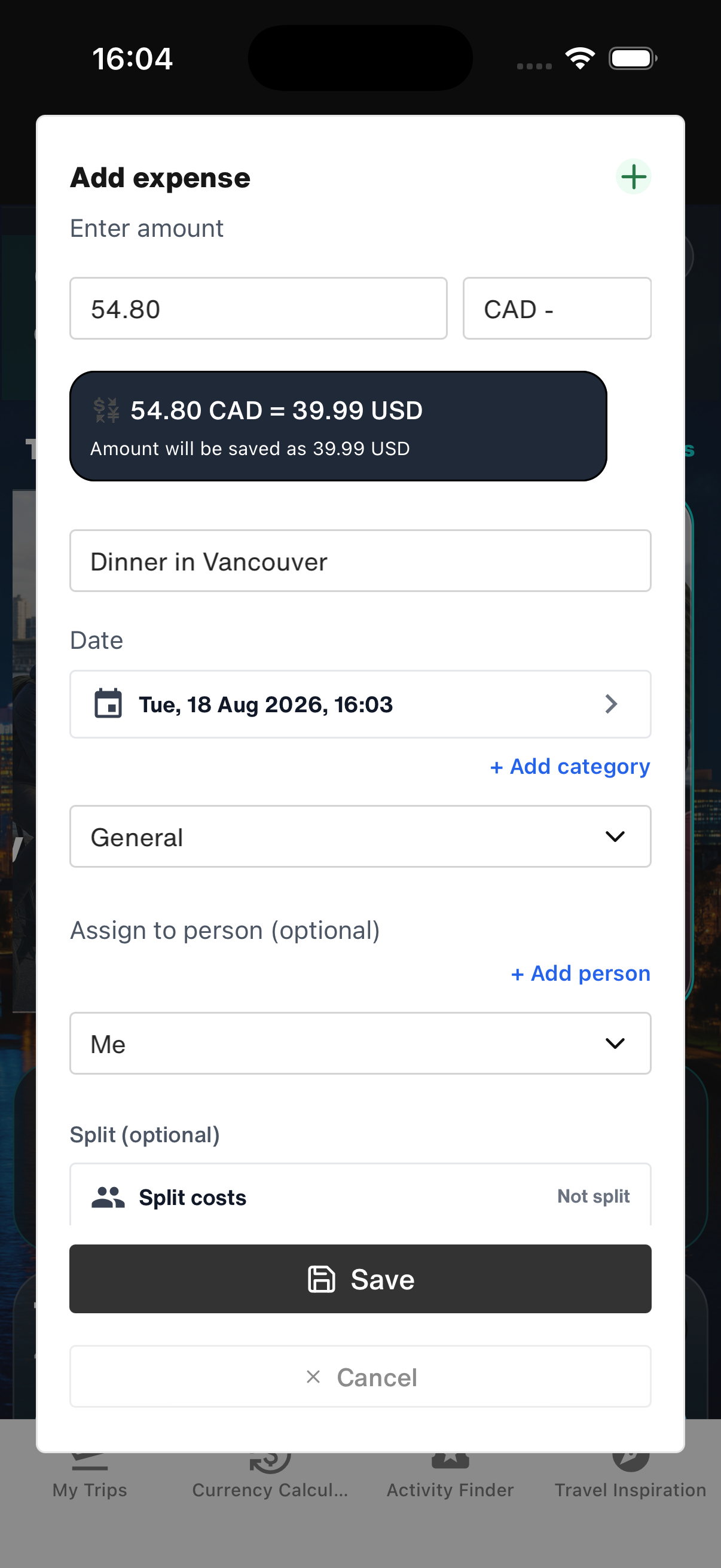
WanderSpend is free to use, ad-free and has no subscription. The official guide to managing a travel budget and expenses explains the Budget Card, categories and shared cost features in detail.
If you would rather compare features, limitations and different workflows first, see our free travel budget app and budget tracker comparison. It covers shared expenses, multiple currencies and which type of tracker fits different trips. Couples, families and friends can also use our step-by-step guide to splitting group travel expenses fairly.
When to rethink the trip
A budget is too tight when several of these are true:
- It only works with the lowest prices you have seen.
- Taxes, baggage, transfers or incidental costs are still missing.
- Almost every day depends on choosing the cheapest possible option.
- The reserve is already needed to make the base calculation fit.
- The accommodation is cheap but creates long or expensive journeys every day.
- The experiences that motivated the trip no longer fit.
- The cost would put pressure on regular expenses or general savings after you return.
In that case, the better answer is usually a shorter trip, a different season, a simpler route or a less expensive destination. That is not failed budget planning. It is exactly what the calculation is meant to reveal.
Checklist before booking
- total ceiling defined
- two or three priorities protected
- prices checked for the actual travel dates
- complete accommodation cost captured for every night
- per-person and shared costs separated
- expensive and lighter day types planned
- transfers, baggage, fees and travel days included
- reserve based on specific risks
- cancellation terms checked
- total trip cost and on-trip spending recorded separately
Trip budget FAQ
How much should I budget per day?
There is no useful universal amount. Use prices at the actual destination and plan several types of day. Divide the complete on-trip budget by the number of days only to get an average.
How large should a trip budget reserve be?
It should reflect the trip's uncertainties. A simple, mostly booked city stay usually needs less flexibility than a road trip or a journey with many connections. Estimate plausible problems in your own currency instead of relying only on a blanket percentage.
Should flights and hotels be included in a daily budget?
Include them in the total trip cost, but not in the variable daily amount. This keeps prepaid costs separate from the spending you can still control on the road.
How should couples or groups calculate a trip budget?
Price flights, admissions and insurance per person. Rooms, rental cars, fuel and parking are usually charged per booking or vehicle and can then be split appropriately.
How can a free budget app help during a trip?
It keeps the planned budget and recorded expenses together. Categories reveal where actual costs are drifting from the plan, while people and split features make shared travel expenses easier to understand.
How often should I check spending during the trip?
Three deliberate checks are enough for many trips: after arrival, around the midpoint and shortly before the final days. Recalculate after any large unplanned expense as well.
Final thought
A good-value trip is not created by making every expense as small as possible. It comes from fitting the large costs to the money available and setting clear priorities for everything else.
Protect what gives the trip its purpose. Simplify the route, dates or repeated extras when the numbers do not work. Use light expense tracking to adjust early instead of scrambling late. And book only when the realistic version fits — not just the most optimistic one.
When several people travel together, our guide to building a group travel budget adds cost splitting, payers and final settlement to this framework.