
Articles
Split Group Travel Expenses – Instantly See Who Owes Whom and How Much
Share group travel costs fairly and instantly see who owes whom and how much, from simple rules to an auditable final settlement.
Shared travel expenses rarely become difficult because someone wants an unfair deal. They become difficult because several questions get mixed together: Who paid? Who was the expense for? Should everyone carry the same share? And which currency should the final settlement use?
The answer is not a complicated group account. It is a clear distinction between the payer and the cost allocation. Once both are correct for every expense, a long list of receipts can become one understandable balance.
The short version:
- Agree what is shared and what is personal before the trip.
- Record who initially paid each expense.
- Allocate the cost equally, individually or entirely to one person.
- Convert everything into one trip currency.
- Settle net balances at the end rather than reimbursing every receipt.
The key distinction: paying does not mean bearing the full cost
One person often covers a bill for several travelers. That does not determine how the cost should ultimately be shared.
For example:
- Restaurant bill: EUR 100
- paid by Alex
- cost allocation: Alex EUR 50, Emma EUR 50
Alex advanced EUR 100 but should bear only EUR 50. Emma therefore owes Alex EUR 50.
A personal expense works differently:
- Hiking boots: EUR 100
- paid by Alex
- cost allocation: Alex EUR 100
The expense still belongs in the trip budget. It has no effect on the group balance because the payer and cost bearer are the same person.
The basic formula is:
A person's balance = amounts paid – their own cost shares
A positive balance means that person should receive money. A negative balance means they still owe money to the group.
Three allocation methods cover almost every trip
A clear settlement does not need dozens of special cases. Three models are usually enough.
1. Personal expense
One person bears 100 percent. This suits personal clothing, a single-room upgrade or an admission used by only one traveler.
The payer can still be someone else. If Emma buys Leo's hiking equipment for EUR 70, Leo carries 100 percent of the cost and owes Emma EUR 70.
2. Equal split
Everyone involved carries the same share. This often works for a rental car, holiday apartment, fuel or groceries bought for the group.
Four travelers split an EUR 800 rental car. Each person's share is EUR 200. If Alex paid the full bill, Emma, Leo and Mia each create an EUR 200 claim in Alex's favour.
3. Custom split
The shares differ. This is useful when a couple uses a larger room, someone joins the trip later or only part of the group takes an activity.
The shares must add up exactly to the full bill. For uneven amounts, the chosen method should also deal with the final cent consistently so that small discrepancies do not accumulate across a long trip.
Rules worth agreeing before departure
A five-minute conversation prevents a surprising number of disagreements. Settle four points before the first large booking.
What counts as a shared expense?
A rental car or holiday apartment may be obvious. Restaurant meals, alcohol, baggage, parking and upgrades can be less clear.
A useful rule is: A shared expense is something the group deliberately uses together or needs for the shared route. Everything else remains personal unless you agree otherwise.
Who records the expenses?
Either everyone records their own payments, or one person collects the receipts. Both approaches work. The problem is an unclear mix, because expenses can then be entered twice or missed completely.
When should shares be adjusted?
Not every small difference needs a custom calculation. If someone arrives two nights later, skips an expensive activity or uses a much larger room, however, a custom share is fairer than an automatic equal split.
When should money actually be transferred?
A mid-trip balance check is useful on a longer journey. The actual repayment is usually best made after the final shared expense. Otherwise, the group creates several transfers that may be reversed by the next bill.
A routine that works without spreadsheet chaos
The calculation only stays reliable when the recording habit is simple enough to use on the road.
- Immediately after payment: record the amount, currency, payer and cost allocation. A receipt photo in the group chat is not yet a complete entry.
- Every two or three days: check whether a large expense is missing, the right people are included and foreign-currency amounts look plausible.
- At the end of the trip: correct the original entries first, then calculate the net balances and make the final transfers.
For a short trip with two or three shared expenses, a note or spreadsheet can still be enough. A structured app becomes useful when several people pay, shares differ, currencies change or the group needs an auditable result.
Worked example: four people on a road trip
Alex, Emma, Leo and Mia record four expenses:
| Expense | Paid by | Cost allocation |
|---|---|---|
| Rental car, EUR 800 | Alex | EUR 200 for each traveler |
| Hiking equipment for Leo, EUR 70 | Emma | Leo EUR 70 |
| Personal lunch, EUR 25 | Alex | Alex EUR 25 |
| Holiday apartment, EUR 480 | Emma | Alex EUR 120, Emma EUR 240, Leo EUR 60, Mia EUR 60 |
After all four expenses, the net balances are:
| Person | Calculation | Balance |
|---|---|---|
| Alex | paid EUR 825, carried EUR 345 | +EUR 480 |
| Emma | paid EUR 550, carried EUR 440 | +EUR 110 |
| Leo | paid nothing, carried EUR 330 | -EUR 330 |
| Mia | paid nothing, carried EUR 260 | -EUR 260 |
All balances add up to zero. Instead of reimbursing each receipt, three transfers settle the group:
- Leo pays Alex EUR 330.
- Mia pays Alex EUR 150.
- Mia pays Emma EUR 110.
Everyone is then settled. The example also shows why the personal lunch disappears from the group balance: Alex both paid for it and carried the full cost.
Multiple currencies: convert first, calculate balances second
Trips quickly combine currencies: a flight in euros, a hotel in Canadian dollars and a stopover in US dollars. For a fair settlement, each expense should first be converted into one common trip currency.
Use this order:
- Save the original amount and currency.
- Keep the exchange rate or converted amount used for the entry.
- Calculate all cost shares in the common trip currency.
- Build each person's balance from those converted values.
Do not combine open amounts in different currencies in one final balance. Otherwise, it becomes unclear whether a difference comes from cost allocation or a later exchange-rate change.
The final card charge can differ slightly from the first conversion shown at checkout. It is worth checking larger expenses again once the payment has settled.
What makes a settlement trustworthy
A result such as “Mia owes EUR 260” is enough to make a transfer. It may not be enough to trust the calculation.
A good settlement therefore has three levels:
- Overview: Who should receive money, and who still owes money?
- Suggested payments: Which small set of transfers settles everyone?
- Audit trail: Which expenses, payers and cost shares created the result?
The audit trail matters when a bill is missing or a share was entered incorrectly. Correcting the original entry is cleaner than adding an invented adjustment whose only purpose is to force the balance to match.
Incomplete data should remain visible too. If an older expense has no payer, a system should not invent a claim. It should state how many expenses were included and which entries still need attention.
Spreadsheet, group fund or app?
A note or spreadsheet is enough for three shared expenses. A common cash fund can work for many small costs that are genuinely split equally. The process becomes harder when several people take turns paying, shares differ or currencies change.
| Method | Best for | Limitation |
|---|---|---|
| Note or spreadsheet | short trip, few expenses, one person in charge | manual formulas and a weak mobile overview |
| Shared cash fund | many small expenses that are truly equal | personal costs and uneven shares |
| Expense-splitting app | several payers, flexible shares, live balances | little context for the wider trip |
| Travel app with a budget | costs should sit next to the route, places and documents | useful only if the group also keeps the trip there |
If you want to compare different approaches first, see our guide to the best travel budget apps. For dedicated group ledgers, our Splitwise vs Tricount comparison explains where each specialist is stronger and when WanderSpend can be sufficient as a travel-app alternative. For the full trip cost, use our step-by-step guide to building a realistic travel budget.
How group settlement is designed to work in WanderSpend
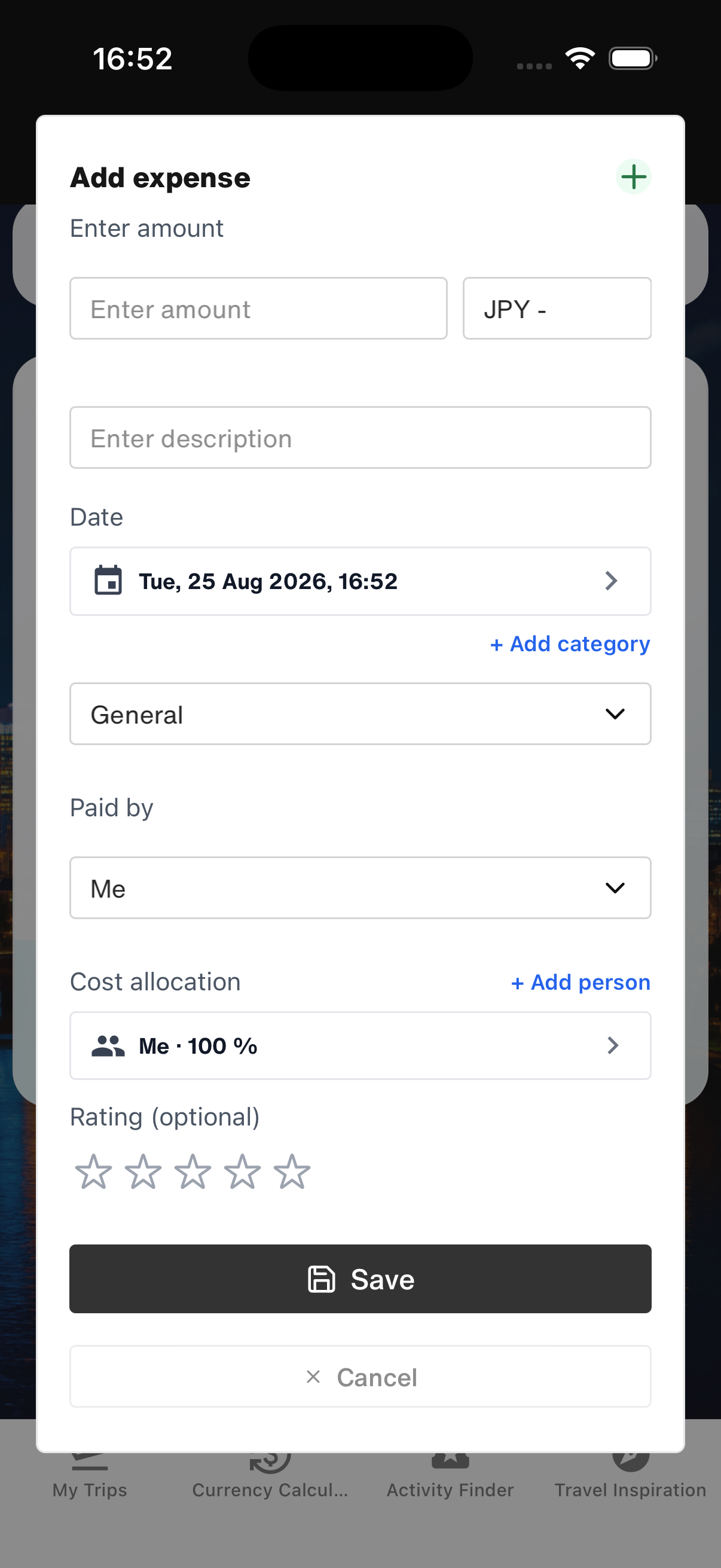
WanderSpend connects expenses with the wider trip: budget, people, currencies, route, documents and timeline stay in one place. Its upcoming balance feature clearly separates Paid by from the Cost allocation of each expense.
On a solo trip, these controls stay hidden and “Me” automatically bears the full expense. Once a trip has at least two people, the payer can be selected and the cost allocation can be split equally or customised. New expenses deliberately start with 100 percent allocated to the payer until the traveler changes the split.
Record payer and cost allocation separately

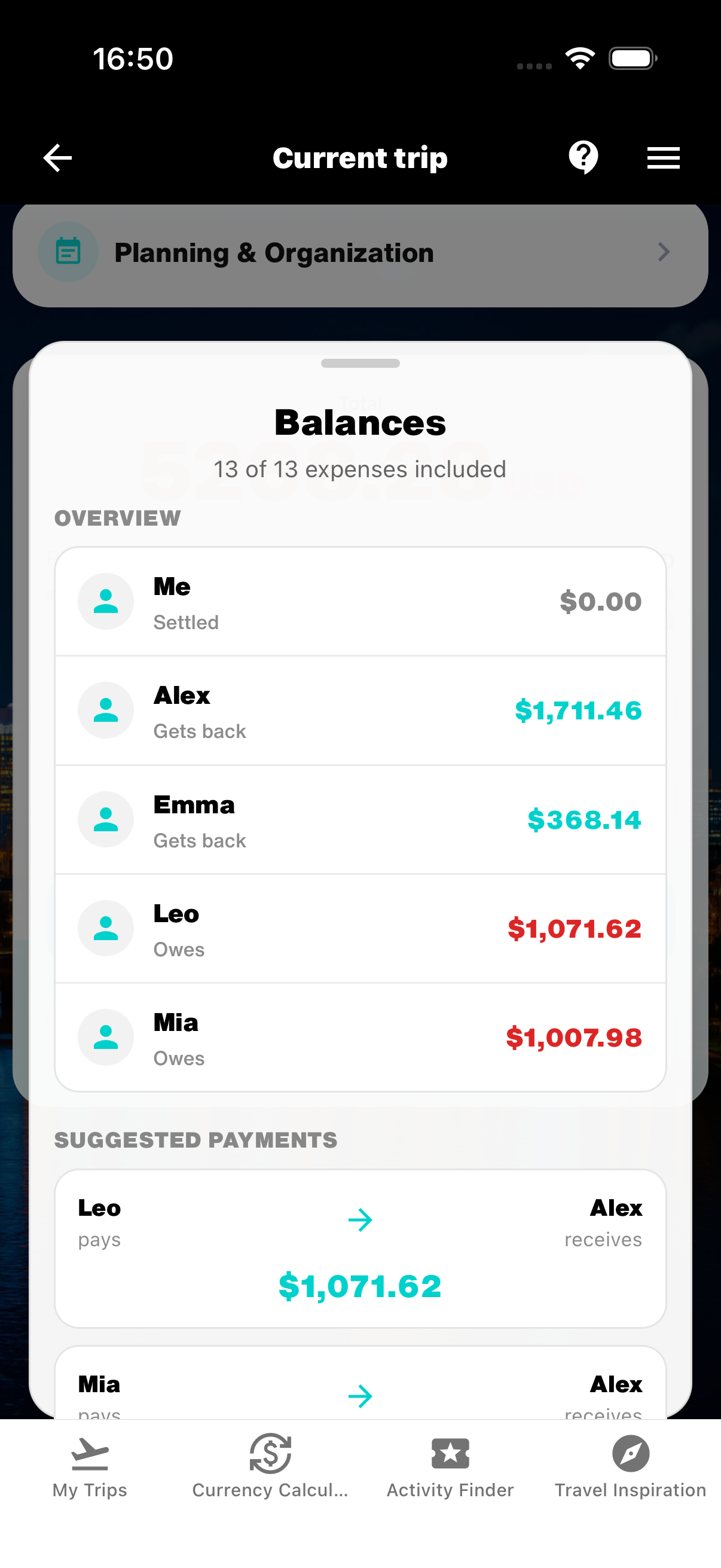
See every balance at a glance
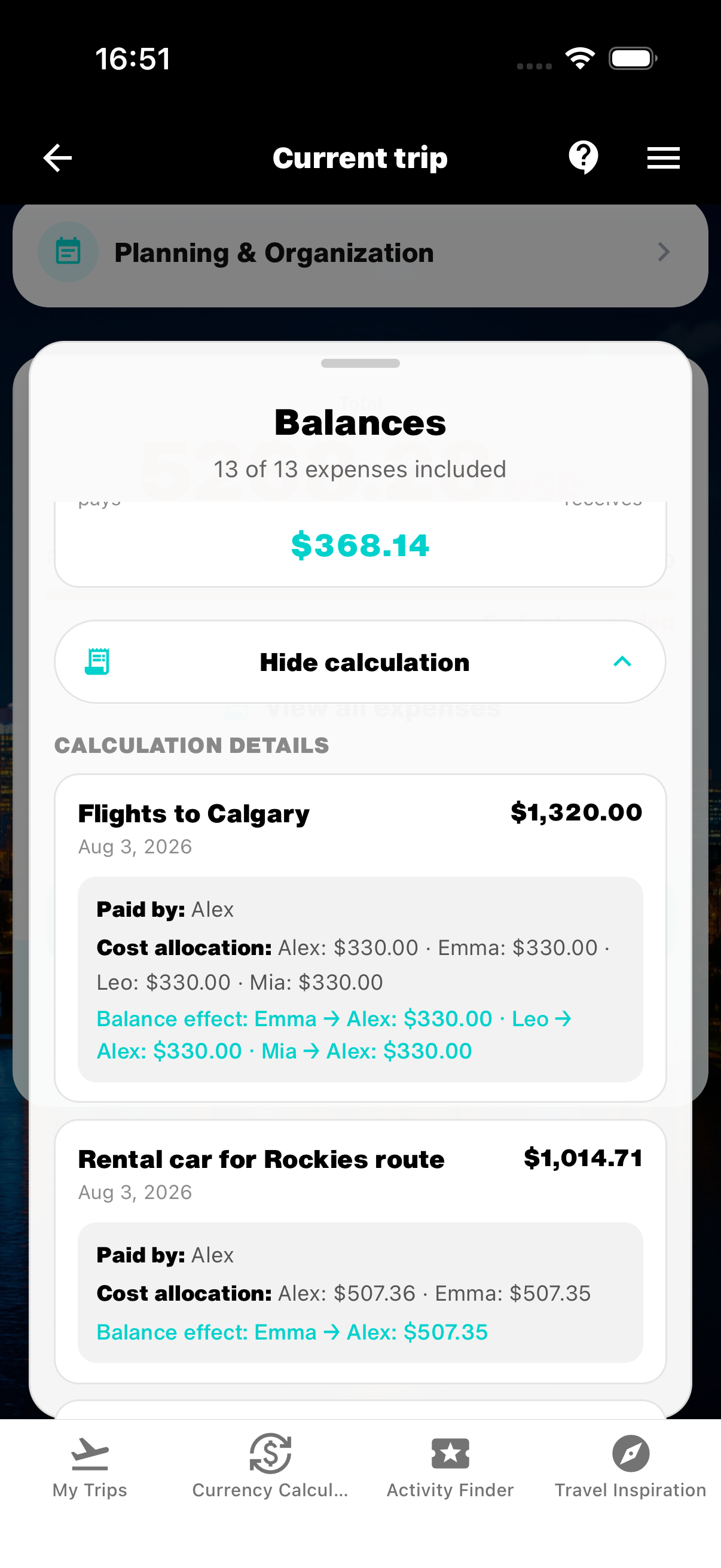
Keep every number auditable
Share payments with the full calculation
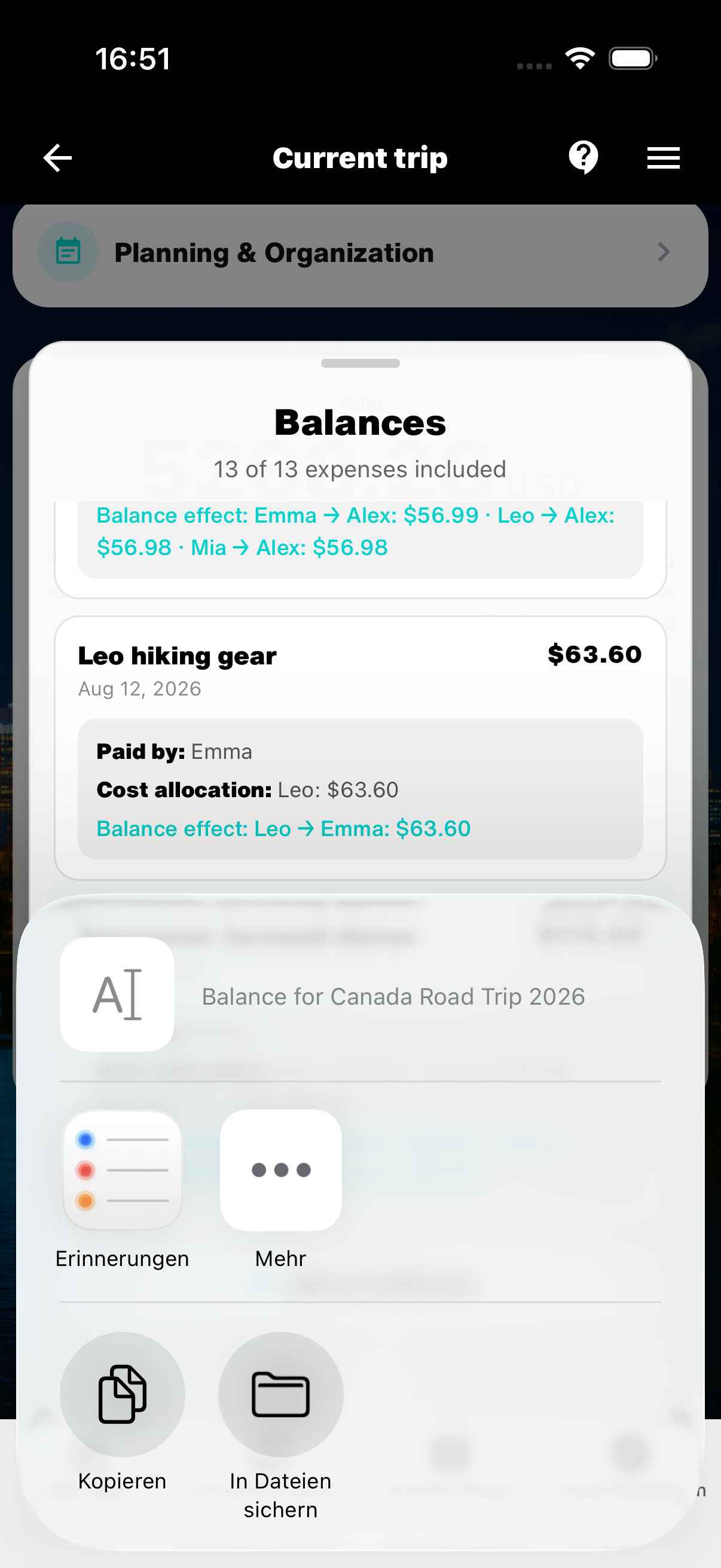
The overview combines all valid expenses in the trip currency and suggests a short list of transfers. Show calculation keeps every entry auditable. Sharing includes both the suggested payments and the full calculation behind them.
The official WanderSpend guide to travel budgets, Cost Split and trip balances shows the complete workflow and all screenshots.
Common mistakes with shared travel expenses
Splitting everything equally by default
This looks simple but becomes unfair when someone arrives later, skips an activity or has personal purchases in the list.
Recording only who paid
“Alex paid” does not say who should bear the bill. Without a cost allocation, every later balance is a guess.
Reimbursing every receipt immediately
This creates unnecessary transfers. Calculate net balances first and settle the group at the end.
Combining different currencies directly
An open amount in CAD and another in EUR do not create a reliable balance without a common conversion basis.
Hiding an error with an adjustment entry
If a bill was split incorrectly, correct that expense. An extra adjustment makes the history harder to understand.
Shared travel expenses FAQ
Should every travel expense be split equally?
No. Equal splits suit expenses everyone uses in roughly the same way. Personal purchases and noticeably different participation should be assigned to the relevant person or split individually.
What is the difference between the payer and a cost share?
The payer initially covered the bill. A cost share describes how much of that bill someone should ultimately bear. The difference between the two creates the balance.
How should personal expenses be handled?
If someone pays an expense that is allocated entirely to themselves, no amount is owed within the group. It remains part of the trip budget but has no effect on group balances.
How do you split travel expenses in several currencies?
Convert every expense into one trip currency using a traceable rate. Calculate the cost shares and balances only in that common currency.
When should a group settle travel expenses?
A mid-trip check can reveal missing or incorrect entries early. The actual transfers are usually best made after the final shared expense.
Does a group need a dedicated app?
Not necessarily. A spreadsheet is enough for a handful of expenses. An app becomes useful when several people pay, shares vary, currencies differ or many entries need to remain auditable.
Final thought
A fair group settlement does not begin on the final evening of the trip. It begins with two clear details on every expense: Who paid, and who should bear each share?
Keep the rules simple, customise only meaningful differences and settle net balances rather than individual receipts. A long list of small payments then becomes one short, auditable close-out — and money remains a practical part of the journey instead of its final argument.
If the group also needs a financial framework before booking, the guide to building a group travel budget covers categories, per-person estimates, contingency and on-trip budget checks.